.png)
Contextual Interference: Why Training Variety Might Be Destroying Your Consistency
- Jul 13
- 4 min read
Ask most coaches how to build a reliable skill and they will describe blocked practice: repeat the same movement over and over until it grooves in. Ask a motor learning researcher and you get a more uncomfortable answer. Since Battig's original work in the 1960s and Shea and Morgan's landmark 1979 study, a robust and counterintuitive finding has held up across dozens of replications: practice that feels harder and produces worse performance during training often produces better retention and transfer later.
This is the contextual interference effect, and it means the training session that looks the most polished may be quietly building the least durable skill.
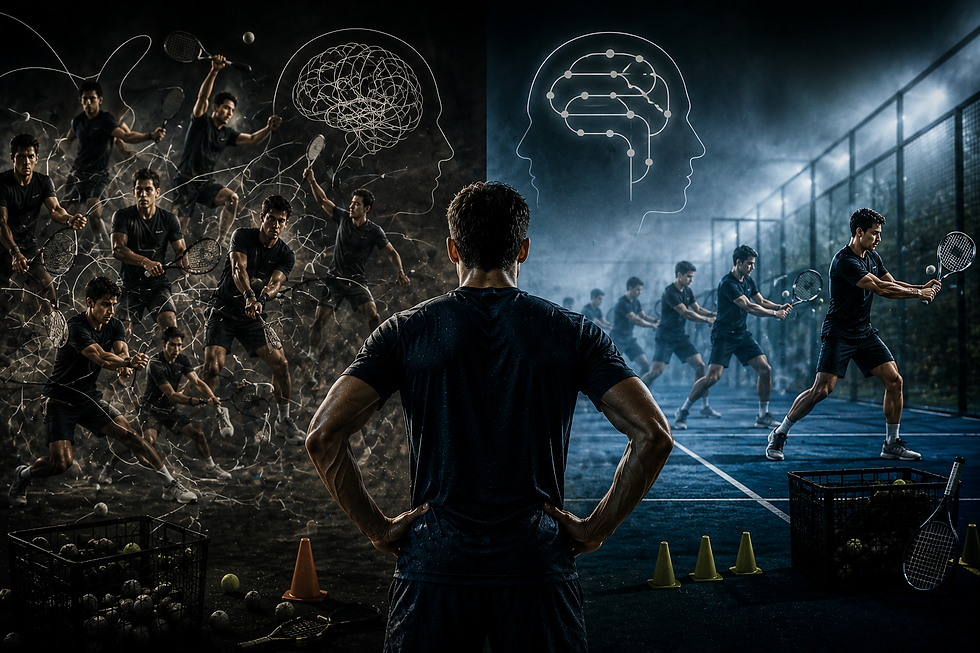
Blocked Practice Feels Good and Learns Poorly
In blocked practice, an athlete repeats one variation of a skill, say the same serve placement in tennis or the same passing lane in basketball, in an uninterrupted sequence before moving to the next variation. Performance improves quickly within the block because the nervous system settles into a stable motor program and stops having to reconstruct it on every repetition. Coaches see rapid, visible improvement and reasonably conclude the training is working.
The problem shows up later, away from the practice environment. Blocked practice produces strong short-term performance but comparatively weak long-term retention and even weaker transfer to game-like conditions, where the skill must be selected and executed among competing options rather than rehearsed in isolation. The smoothness observed in blocked training is partly an artifact of not having to retrieve the motor plan from scratch each time.
This mismatch between how a skill looks during acquisition and how it will actually be used in competition is the central trap of blocked practice. Athletes and coaches routinely mistake in-session fluency for learning, when much of that fluency is a temporary byproduct of repetition rather than a durable change in the underlying motor program.
Why Interference Builds Deeper Learning
Random or high-interference practice deliberately disrupts this comfort. Instead of grouping repetitions of one skill together, the athlete alternates between different variations from trial to trial, forcing the motor system to abandon the previous solution and reconstruct a new one on almost every attempt. This is cognitively and physically more demanding, and it shows up immediately as messier, more error-prone performance during the session itself.
The leading explanation is the elaboration and reconstruction hypothesis: because each new trial requires actively retrieving and reconstructing the appropriate motor program rather than simply continuing an ongoing one, the learner engages in deeper, more effortful memory processing. This effortful retrieval is what strengthens the memory trace and makes it more resistant to forgetting and more flexible under novel conditions.
A second contributing mechanism is forgetting itself. The interruption caused by switching between variations partially decays the short-term motor trace of the previous skill, forcing genuine retrieval rather than passive continuation on the next attempt at that skill. Counterintuitively, this partial forgetting between attempts is part of what makes the learning stick.
Reading the Effect Correctly in a Team Setting
The contextual interference effect is strongest when the skills being interleaved are similar enough to require genuine motor discrimination, such as different types of passes, shots, or footwork patterns within the same broad skill family. Interleaving completely unrelated skills, like a strength exercise and a technical drill, does not reliably produce the same benefit, because there is no shared motor program being reconstructed and refined.
The effect also interacts heavily with skill level and task complexity. Novice athletes and highly complex skills sometimes need a baseline of blocked repetition before high-interference practice becomes productive rather than simply overwhelming. A skill that has no stable foundation yet cannot be meaningfully reconstructed trial to trial, because there is no coherent motor program to reconstruct.
This is why the honest reading of the research is not that variety is always superior in every training moment, but that a training block dominated entirely by low-interference repetition is very likely to be under-preparing athletes for the variable, high-decision demands of actual competition, regardless of how good it looks on the training pitch.
Applying It Without Sacrificing Confidence
Practically, this argues for a staged approach: use blocked practice briefly to establish the basic coordination pattern of a genuinely new skill, then shift as quickly as possible into randomized or serial practice that interleaves that skill with closely related variations the athlete will actually have to choose between in competition.
Coaches should also manage expectations, including their own, about what training performance predicts. A session with more visible errors is not necessarily a worse session; if the athlete is being asked to interleave meaningfully different, closely related skills, some of that mess is the mechanism, not a warning sign.
Finally, testing protocols matter. Evaluating athletes only in a blocked, low-interference format will systematically overestimate what they can do in competition, where skill selection under pressure is the actual demand. Building periodic randomized assessments into testing gives a far more honest read on what athletes have actually retained and can transfer under game conditions.


Comments