.png)
The Rhythm Problem: Why Temporal Prediction Failures Precede Performance Collapse
- Jun 8
- 3 min read
Every sport has a heartbeat. A goalkeeper learns the striker's shot timing. A batter reads the pitcher's delivery pattern.
A tennis player anticipates the server's rhythm. Yet rhythm isn't taught as a measurable psychological variable — it's treated as intuition. The data shows something different: athletes who lose temporal prediction accuracy collapse in performance long before their technical skill declines.
Understanding rhythm as a psychometric variable changes how we identify vulnerability and train mental resilience.
What Is Temporal Prediction, and Why Does It Matter?
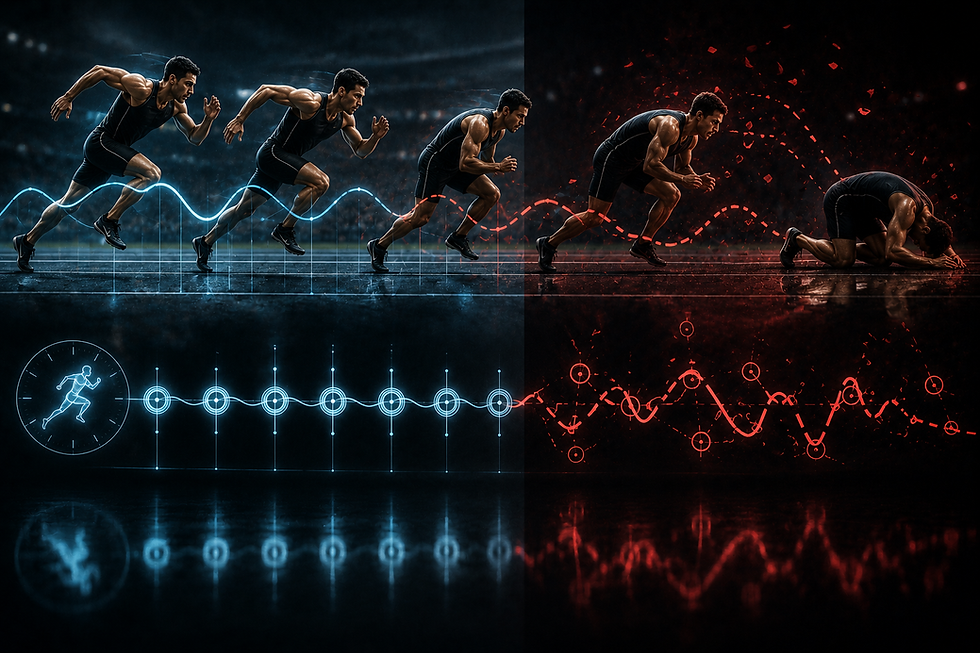
Temporal prediction is the brain's ability to anticipate the timing of incoming stimuli or pattern cycles. It's not just reaction speed — it's the neural expectation of *when* something will happen. In competitive sport, rhythm violations (unexpected timing breaks) trigger cognitive load spikes that exceed an athlete's processing capacity.
Research in sports neuroscience shows that elite athletes possess superior temporal prediction networks, allowing them to pre-activate motor and cognitive responses before events occur. This isn't reflexive; it's learned, measurable, and trainable.
When rhythm breaks — a coach changes their feedback pattern, an opponent shifts their tempo, environmental noise disrupts audio cues — temporal prediction fails. The athlete's brain defaults to reactive mode instead of anticipatory mode, which costs milliseconds but more importantly costs confidence. That loss of predictability is where performance crumbles.
The Predictability-Confidence Link: Why Uncertainty Kills Performance Before Pressure Does
Pressure itself doesn't break athletes. Unpredictability does. A crucial distinction.
An athlete facing a strong opponent with a consistent, readable rhythm can perform at a high level under pressure because their temporal prediction system is calibrated.
The same athlete facing an opponent with an erratic, rhythm-disrupted style crumbles — not because the pressure is higher, but because their brain cannot construct an anticipatory model.
This explains why some athletes dominate at home (familiar rhythm, controlled variables) but falter away (unfamiliar timing patterns, crowd rhythm interference). It's not mental weakness. It's temporal prediction miscalibration.
Coaches who recognize this deploy rhythm-stabilization strategies: consistent routines, predictable feedback timing, and deliberate exposure to rhythm variation. Athletes with high temporal prediction stability maintain confidence across contexts.
Measuring Temporal Prediction: From Milliseconds to Movement Patterns
How do you measure something as abstract as rhythm prediction? Neuroscience offers precise tools. Event-related potentials (ERPs) like the Contingent Negative Variation show the brain's anticipatory readiness before expected stimuli.
Reaction time variance — the consistency of response timing across repetitions — indicates predictive stability.
Motion capture analysis reveals whether an athlete pre-activates movement patterns (indicating rhythm anticipation) or activates reactively (indicating rhythm failure).
At a practical level, coaches can assess temporal prediction through anticipation drills: reaction time tasks with varying stimulus intervals, video-based sport-specific prediction tests, and rhythm-matching exercises. Athletes with high temporal prediction accuracy show low reaction time variance, earlier movement initiation, and faster recovery to disrupted rhythms. This data becomes part of the performance profile, just like decision-making speed or emotional regulation metrics.
Rhythm Disruption as a Training and Selection Variable
Elite performance requires not just stable rhythm prediction, but rhythm adaptation — the ability to recalibrate when opponents intentionally disrupt timing patterns. This is where competitive psychology becomes measurable. Training protocols that deliberately introduce rhythm variability — inconsistent coaching feedback timing, opponents with non-standard patterns, environmental unpredictability — build adaptive temporal prediction networks.
In talent identification, temporal prediction stability predicts long-term career success better than raw reaction speed, because rhythm-stable athletes adapt across contexts. They transfer skills faster to new teams, recover quicker from competitive disruption, and maintain confidence against unpredictable opponents.
The athlete with a 200ms reaction time but poor rhythm prediction will struggle. The athlete with a 210ms reaction time but exceptional temporal prediction will dominate.


Comments